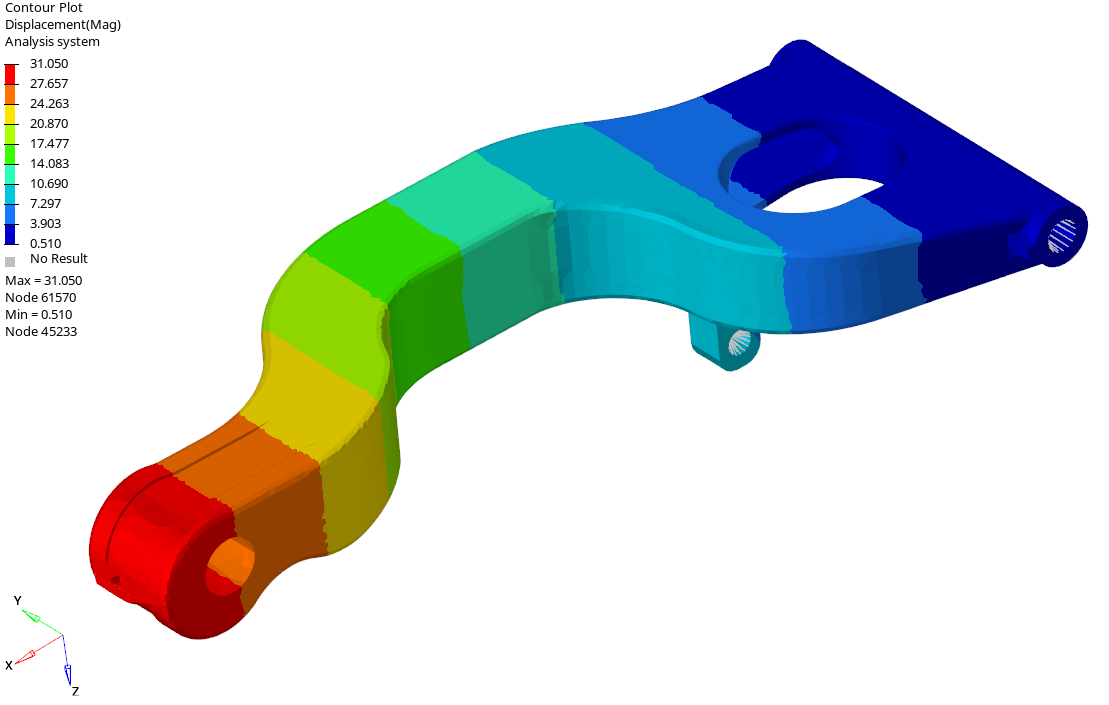
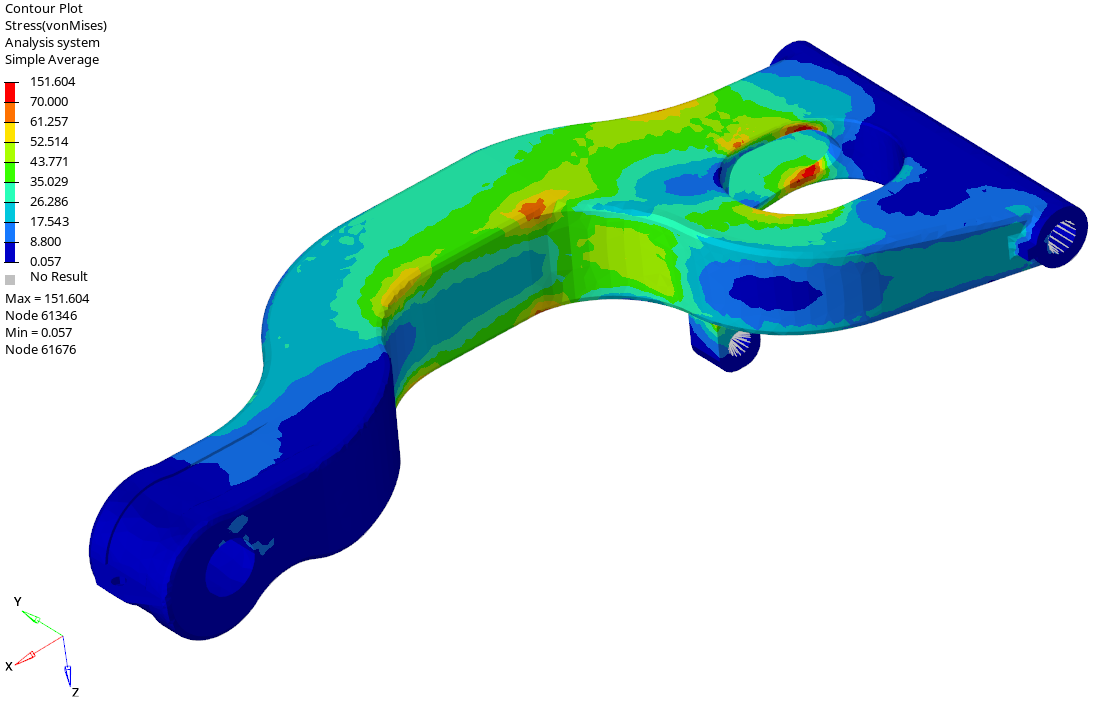
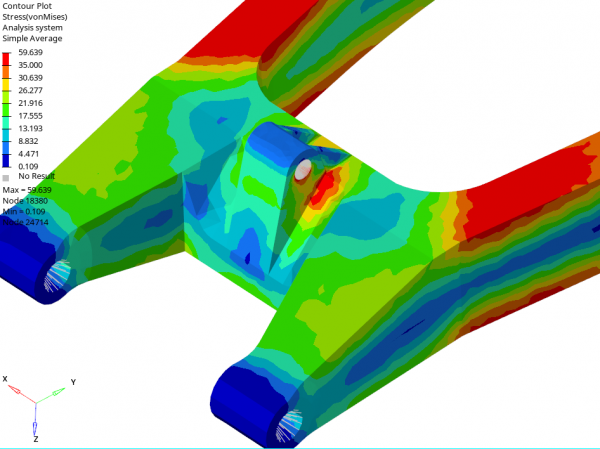
The purpose of static analysis is to examine the system's response to a given load. The load is constant and does not change over time. The tested system must be supported and have all 6 degrees of freedom constrained. Thanks to static tests, we are able to learn about the most stressed areas of the tested structure, as well as the values of displacements and deformations. Already at the design stage, we can modify the geometry to meet the design assumptions. We perform linear and non-linear static analyses. We take into account all types of nonlinearity - material nonlinearity, geometric nonlinearity (large deformations) and we model contact issues. The carried out static calculations of the motorcycle swing arm are presented below.
Dynamic analysis
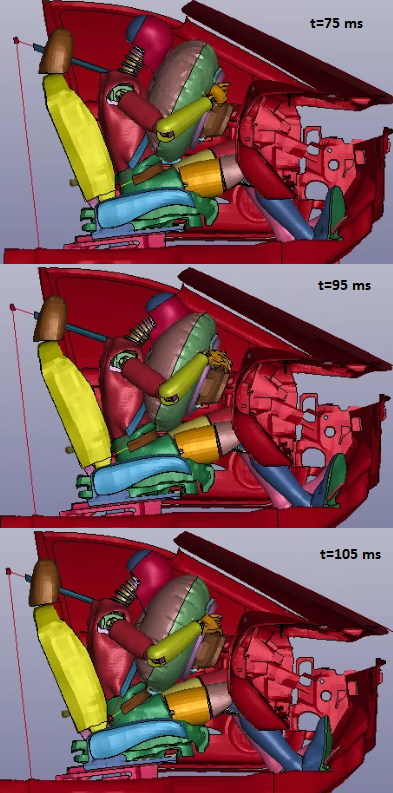
Dynamic tests are carried out to examine the response of the system to a time-varying load. Dynamic effects affecting the tested system are taken into account, e.g. inertia forces, e.g. during collisions. By carrying out a simulation, e.g. of a vehicle collision, we are able to estimate the probability of serious injury to the human body or to examine the energy-intensive properties of the vehicle. In dynamic analyses, we take into account all types of non-linearity - material non-linearity, geometric non-linearity (large deformations) and we model contact issues. The performed crash simulations are presented below.
Front impact at 50 km/h
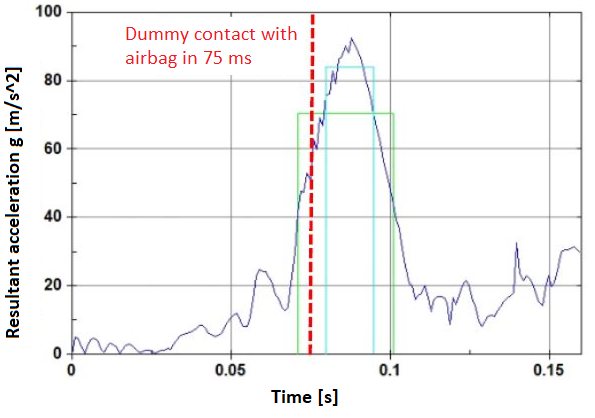
Acceleration of the head amax= 75 g, hic15=612, hic36=885
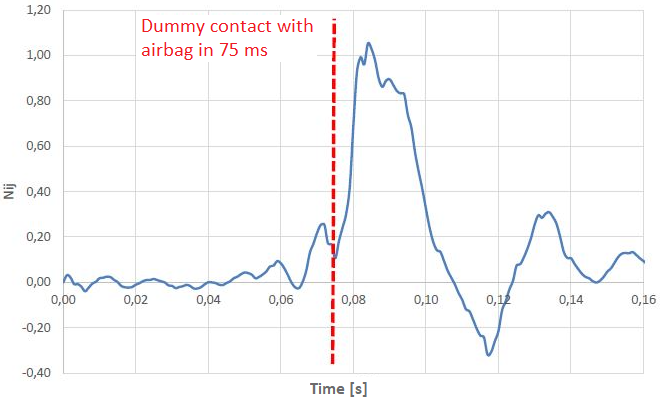
The course of the Nij neck injury criterion
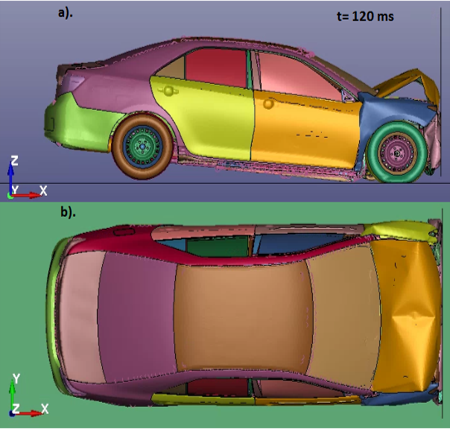
Front impact at 50 km/h of a Toyota Camry (based on VIN4T1BF1FK2CU079329).
Vehicle deformation during a frontal impact a) front view b) top view
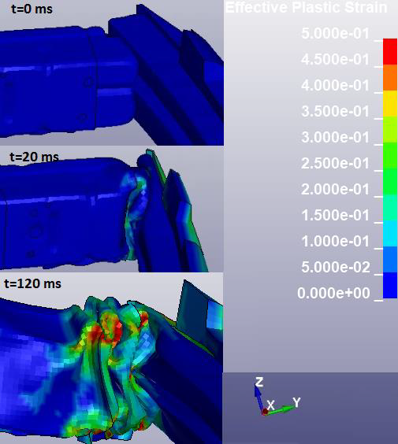
Map of effective plastic deformations of the vehicle longitudinal member
An important role during a collision is played by car side members, which are responsible for the appropriate stiffness and bending resistance of the entire structure.
Modal analysis
Modal analyzes are carried out e.g. in order to determine the eigenfrequency of the tested system and their form. Thanks to them, we learn the frequencies at which the system can fall into resonance. So we can change the geometry already at the design stage in such a way as to eliminate unwanted natural frequencies. The carried out modal analysis of the frame structure is presented below.
Thermal analysis
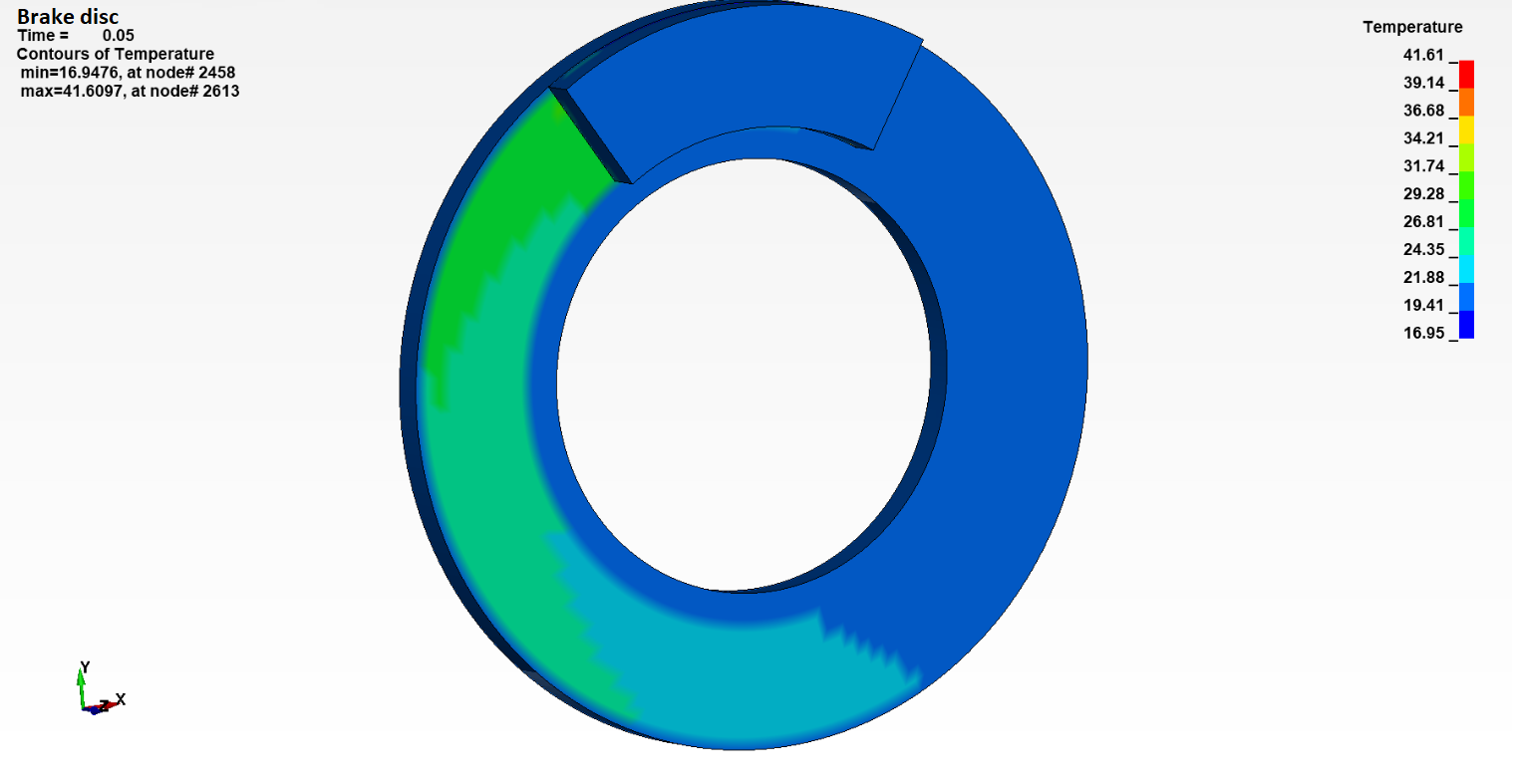
Thermal analyzes and coupled thermo-mechanical analyzes are performed, e.g. in order to know the influence of temperature on the tested system. Thanks to them, we are able, for example, to know the temperature distribution in the tested system or to find out what deformations / displacements will occur in it as a result of its changes. The carried out thermo-mechanical analysis of the brake is presented below.
Fatigue analysis
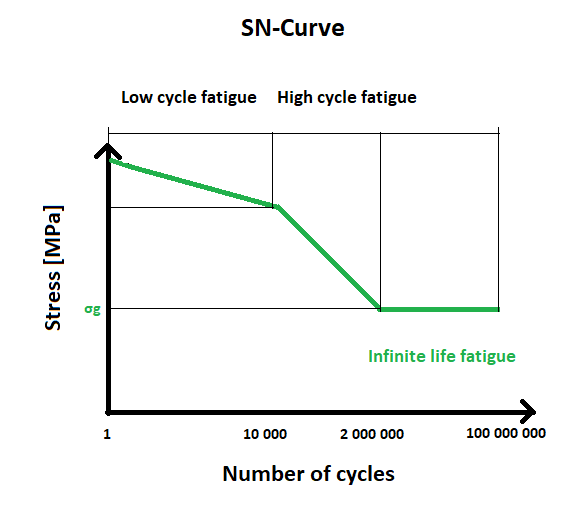
Based on the FEM analysis, we are able to determine the stressed cycle and select the most stressed areas where the fatigue life will be the lowest. By selecting the appropriate fatigue curve, we can calculate the number of cycles at which the tested structure will fail. Fatigue life in welds is much lower than in solid material. Therefore, fatigue analyzes are most often performed for welded joints based on the guidelines of the International Welding Institute.
Multibody analysis
Multibody analyzes (kinematic and dynamic analyzes) are something completely different than classic FEM calculations. The main difference is that in simulations of this type, a model/mechanism is built from rigid parts. Then, its kinematic properties are tested (e.g. whether there will be a collision of individual parts of the tested model during movement) or dynamic properties (e.g. what forces will arise in the suspension elements as a result of the car passing over unevenness in the road). The phenomenon of multibody analyzes is the short calculation time and the ability to build large models in a relatively short time. The obtained forces acting on individual parts of the tested model can be used to perform FEM strength calculations of a single component or the entire model.
Ta strona korzysta z ciasteczek aby świadczyć usługi na najwyższym poziomie. Dalsze korzystanie ze strony oznacza, że zgadzasz się na ich użycie.